AI FORGE Files: The Model
Insights on moving from AI experimentation to Exponential Enterprise Impact!

Issue #1
From AI Productivity to Exponential Enterprise Impact
Exactly 1,200 days ago, generative AI entered the workplace with the release of ChatGPT 3.5.
Since then, millions of professionals have quietly changed how they work.
Reports are written faster.
Code is generated instantly.
Research that once took hours now takes minutes.
Across industries, organizations are reporting meaningful gains in personal productivity.
But something strange is happening.
Despite widespread AI adoption, most organizations have not yet fundamentally changed how they operate.
Productivity has improved.
Transformation has not.
This raises an uncomfortable question for executives and technology leaders:
What does it actually take to move from AI productivity to AI-powered enterprises?
The Personal Productivity Plateau
Today many organizations are experiencing what could be called the Personal Productivity Plateau.
Employees are discovering ways to work faster.
Teams are experimenting with AI tools.
Innovation pockets are appearing across departments.
These are real and valuable gains.
But they rarely translate into enterprise transformation.
Why?
Because true AI transformation requires coordinated progress across four domains:
People: skills, literacy, culture
Processes: workflow design and operational alignment
Technology: data platforms, integration, and infrastructure
Governance: trust, policy, and risk management
Without alignment across these areas, AI adoption fragments into isolated experiments.
The result looks familiar to many leaders:
disconnected tools
inconsistent policies
siloed innovation
unclear governance
limited enterprise impact
Organizations become AI-curious, but not yet AI-transformed.
The Real Promise of AI
The true promise of generative and agentic AI is not simply faster tasks.
The real opportunity is something much larger:
Exponential Enterprise Impact (EEI)
EEI occurs when AI stops being a productivity tool and becomes part of the operating fabric of the organization.
Instead of improving individual work, AI begins to reshape how the enterprise:
operates
coordinates
innovates
competes
Achieving that shift requires a structured way to think about AI maturity.
That is the purpose of the FORGE Model.
The FORGE AI Maturity Model
The FORGE model describes how organizations evolve their AI capabilities over time.
Rather than focusing on tools, the model focuses on organizational capability development.
FORGE consists of five stages.
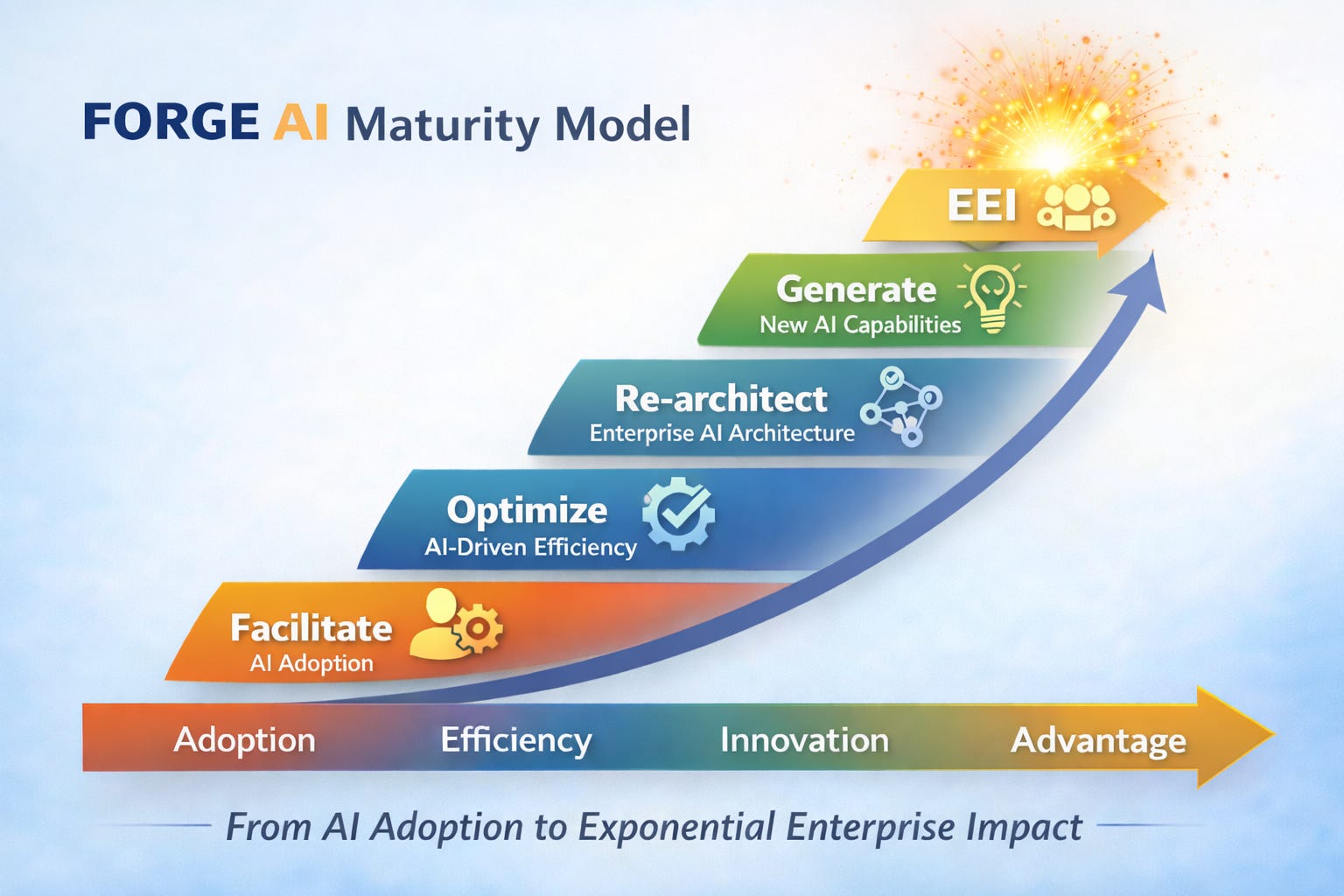
F — Facilitate
The first stage focuses on enabling broad adoption.
Organizations introduce accessible AI tools and build AI literacy across the workforce.
The goal is to create confidence and unlock immediate productivity gains through safe experimentation.
Examples include:
enterprise access to generative AI tools
AI literacy programs
no-code or low-code AI tools
responsible use guidelines
At this stage, AI primarily empowers individual workers.
O — Optimize
Once adoption spreads, organizations begin improving existing workflows.
AI becomes a mechanism for making processes faster, cleaner, and smarter.
Examples include:
automated document processing
AI-assisted customer support
software development acceleration
intelligent workflow automation
The organization becomes more efficient.
But the underlying systems remain largely unchanged.
R — Re-architect
This stage represents the first major inflection point.
Instead of optimizing isolated workflows, organizations begin re-architecting how systems connect.
Siloed tools and data sources are integrated through orchestration, shared platforms, and AI agents.
Capabilities begin to include:
cross-system workflow orchestration
enterprise knowledge systems
integrated data platforms
low-code AI agents
At this stage, AI begins reshaping how the organization actually operates.
G — Generate
With integrated systems in place, organizations can begin creating entirely new capabilities.
Agentic AI systems enable the creation of new processes, new products, and new ways of delivering value.
Examples include:
autonomous research assistants
AI-driven decision systems
adaptive service delivery models
AI-enabled product innovation
The organization moves beyond optimization and begins generating new value.
E — EEI — Exponential Enterprise Impact
The final stage represents AI-enabled competitive differentiation.
Organizations deploy advanced agentic systems and specialized AI platforms that are difficult for competitors to replicate.
At this point, AI becomes embedded within the enterprise itself.
This is where organizations achieve Exponential Enterprise Impact (EEI).
Growth shifts from incremental improvement to structural advantage.
A Critical Leadership Insight
AI maturity is not linear.
Organizations should not try to complete one stage before beginning another.
In practice, multiple FORGE stages operate simultaneously.
A company may still be facilitating AI adoption across the workforce while also:
optimizing financial workflows
re-architecting research infrastructure
generating new AI-enabled services
The goal is not to “finish” a stage.
The goal is to build capability across stages while maintaining institutional coherence.
This is where leadership becomes essential.
AI Transformation Is a Leadership Challenge
AI maturity is not primarily a technology problem.
It is an organizational leadership challenge.
Leaders must coordinate progress across:
People: workforce capability and culture
Processes: operational design and workflows
Technology: data infrastructure and AI platforms
Governance: trust, policy, and risk management
Without alignment across these areas, AI adoption remains fragmented.
The FORGE model provides a shared operating lens to guide this transformation.
The Next Phase of AI
The first wave of generative AI improved how individuals work.
The next wave will reshape how organizations operate.
The organizations that thrive in the coming decade will not simply adopt AI tools.
They will rethink the enterprise itself.
They will move beyond productivity gains toward Exponential Enterprise Impact.
They will FORGE the future with AI.
In the Next AI FORGE File
In upcoming issues we will explore:
why many organizations stall after the Facilitate stage
the hidden risks of uncontrolled AI optimization
why Re-architecting enterprise systems is the hardest step
how agentic AI will reshape organizational design
what it takes to achieve Exponential Enterprise Impact
how to measure the Annualized Economic Impact of AI
The age of AI productivity has begun.
The age of AI-powered enterprises is just getting started.
Author
Leo Howell
CIO and technology leader focused on AI strategy, enterprise transformation, and the future of AI-powered organizations.
I think you are generally on the right track. I will add this: FOMO is a factor driving enterprise interest. Many of the same enterprises committing to AI seem to have a new found interest in efficiencies, but more from a perspective of getting left behind. As a comparison, when RPA was all the thing, the majority of corporate RPA purchased licenses went unused.